

Most writing advice sounds smaller than it really is.
Write short sentences. Cut extra words. Use active voice. Choose specific verbs. Make the first sentence interesting.
These rules are useful, but they are also easy to misunderstand. They can make writing sound like a cosmetic exercise, as if good prose were just bad prose with fewer words.
The deeper principle is stronger than that.
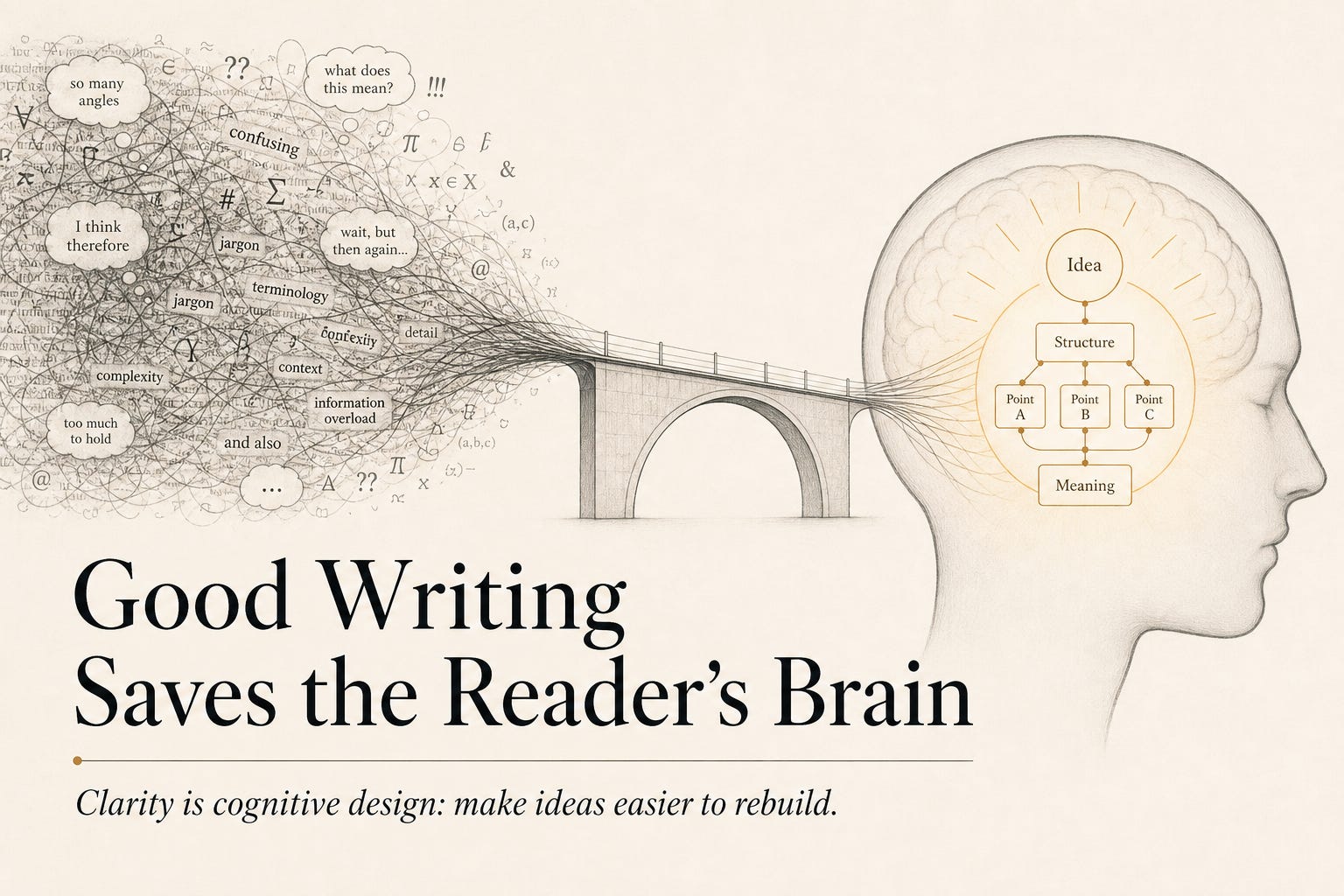
A reader is not passively receiving your thoughts. A reader is rebuilding them.
Every sentence asks the reader to identify a subject, follow an action, connect ideas, remember context, and form a mental picture. If the sentence is simple, the reconstruction is easy. If the sentence is bloated, abstract, or badly ordered, the reader has to do extra work before they can even decide whether they agree.
That is where a lot of writing fails.
It does not fail because the idea is weak. It fails because the idea is expensive to understand.
Good writing lowers that cost.
A clear sentence does not merely look clean on the page. It changes what happens inside the reader’s mind. It reduces the number of things the reader must hold at once. It puts cause before effect. It gives the brain a subject, an action, and an object in an order it can simulate. It replaces vague intensifiers with words that create a scene.
The result feels like style, but the mechanism is closer to interface design.
A good sentence is a usable interface for a thought.
The Reader Is Building a Model
When people say they “understand” a sentence, the word makes comprehension sound instant.
It is not instant.
Understanding is a small construction project. The reader sees words, assigns meaning, tracks grammar, infers relationships, and builds a provisional model of what is happening. Then the next sentence modifies that model.
A simple sentence makes this easy:
The boy hit the ball.
The reader can picture it immediately. There is a subject, an action, and an object. The mental movie starts in the right place.
Now compare it with:
The ball was hit by the boy.
The meaning is nearly the same, but the reconstruction path is less natural. The reader meets the ball first, waits for the action, then has to attach the boy afterward.
This is not a moral argument against passive voice. Passive voice has uses. The point is more basic: word order affects mental order.
Writing is not just what you say. It is the sequence in which the reader has to process it.
That sequence matters because attention is limited. Every sentence consumes a little working memory. The reader must remember what has already been said while interpreting what is being said now. If a sentence is long, abstract, or full of qualifications, the reader has to carry too many unfinished pieces.
At that point, the problem is no longer literary. It is cognitive.
The reader is not asking, “Is this sentence elegant?”
The reader is asking, often silently, “Can I keep following this without strain?”
When the answer becomes no, they drift. They may keep their eyes on the page, but the thought has already lost them.
Clarity Persuades Before Argument Begins
This explains why simple writing is persuasive.
Persuasion does not begin when the reader evaluates your conclusion. It begins earlier, when the reader decides whether your thought is worth the effort of reconstructing.
A complicated paragraph can contain a good argument. But if the reader spends most of their energy decoding the paragraph, there is little energy left for being moved by it.
This is why more explanation does not always create more persuasion.
Writers often respond to weak writing by adding more. More background. More caveats. More adjectives. More examples. More signals that the idea is important.
Sometimes that helps. Often it makes the problem worse.
If the reader is lost, additional material is not support. It is more terrain.
The first job is not to add weight to the argument. The first job is to make the argument visible.
Once the reader can see it, you can strengthen it. Before that, you are decorating fog.
Clear writing creates trust because it gives the reader a feeling of contact with the idea. They can see what is being claimed. They can see what follows from what. They can see where they might disagree.
That last part matters.
A clear argument is not one that forces agreement. It is one that makes agreement or disagreement possible.
Muddy writing often feels sophisticated because it prevents precise objection. But that is a weak kind of sophistication. It hides the idea from criticism by hiding it from comprehension.
Good writing takes the opposite risk. It makes the idea easy to inspect.
That is why clarity feels confident.
Simplicity Is Compression, Not Thinness
The most common objection to simple writing is that it sounds too simple.
Many writers fear that short sentences will make their ideas feel shallow. They want the prose to carry the weight of the thought, so they add complexity: longer sentences, more abstract nouns, heavier transitions, more formal phrasing.
But complexity in the sentence is not the same as complexity in the idea.
In fact, the better the idea, the more it benefits from clean delivery.
Simple writing is not saying less. It is making each word do real work.
Consider a small example:
He was very happy.
The sentence is clear, but it is weak. The word “very” claims intensity without giving the reader anything to see. It increases volume without increasing information.
Now compare:
He beamed.
One word does more than “very happy.” It gives the reader a face, a physical expression, and a more specific emotional state.
This is the difference between cutting and compressing.
Cutting removes what does not carry meaning. Compressing replaces weak meaning with stronger meaning.
The best simple writing does both.
It deletes words that only pretend to help, then replaces generic language with precise language. This is why a vivid verb can outperform a pile of adjectives. A verb can carry action, mood, status, and character at once.
“Drink” reports behavior.
“Swill” reports behavior with a judgment attached. It suggests speed, looseness, appetite, maybe even contempt. It gives the reader a small social scene.
A good word is not good because it is fancy. It is good because it reduces the amount of explanation required.
Specificity is a form of economy.
Bad Writing Outsources the Work to the Reader
A useful way to diagnose writing is to ask: who is doing the labor?
In weak writing, the author has often avoided the hard work of selection. They put everything on the page: the premise, the background, the caveat, the adjacent thought, the emotional emphasis, the abstract claim, and the half-formed example.
Then the reader has to sort it out.
This feels thorough to the writer, but it feels expensive to the reader.
Good writing reverses that burden. The writer does the sorting before the reader arrives.
The writer decides what comes first. The writer removes the extra words. The writer chooses the example that makes the idea visible. The writer breaks one overloaded sentence into two. The writer replaces a vague claim with a concrete action.
That is why editing is not cleanup. Editing is thought work.
When you cannot write a sentence clearly, the problem is often upstream. You may not know which idea is central. You may not know what the reader already understands. You may not know what conclusion the paragraph is supposed to move toward.
The sentence exposes the confusion.
This can be uncomfortable because it means writing is not merely expression. It is a test of understanding.
A vague paragraph lets you feel as if you have captured a thought. A clear paragraph forces you to discover whether the thought actually holds together.
The First Sentence Is a Contract for Attention
The first sentence has a special job.
It does not need to explain everything. It does not need to prove everything. It does not need to be clever.
It needs to create a reason to continue.
A strong opening often reveals a useful gap. It gives the reader a small unresolved tension: a surprising claim, a familiar problem stated cleanly, or a promise that feels specific enough to trust.
The important word is “useful.”
A cheap hook creates curiosity that the piece cannot honor. A good opening points directly at the real work of the essay.
For example, the claim “I became a better writer after a one-day business writing course” works because it creates a genuine question: what could be simple enough to learn in a day, yet powerful enough to change someone’s writing?
That question pulls the reader forward.
The opening does not win attention by shouting. It wins attention by creating an honest gap between what the reader knows and what the reader now wants to know.
This is why many competent essays still feel dull. They begin with throat-clearing. They explain the category before they create the need. They give background before tension.
But attention is granted before background is processed.
If the reader does not know why they should care, context becomes weight.
Writing as User Experience
The closest modern analogy for good writing may be product design.
A product designer cares about what the user is trying to do, what they see first, where they hesitate, which steps are confusing, and how many decisions they must make before reaching value.
A writer should care about the same things.
Every sentence is part of the reader’s path. Every paragraph either reduces friction or adds it. Every vague phrase is a hidden button. Every overloaded sentence is a cluttered screen. Every unnecessary preamble is a slow onboarding flow.
This analogy is useful because it moves writing away from self-expression and toward reader experience.
The question changes from “How do I sound?” to “What does this make the reader do?”
Does the reader have to reread?
Does the reader have to guess what “this” refers to?
Does the reader have to wait too long for the verb?
Does the reader have to translate abstract nouns into concrete stakes?
Does the reader know why this paragraph follows the previous one?
A lot of writing improves immediately when judged this way.
Take a common business sentence:
Our platform is a very powerful and innovative tool that helps users efficiently manage different kinds of complicated workflows.
The sentence is not wrong. It is just full of low-information praise. “Powerful,” “innovative,” and “efficiently” ask the reader to accept value without seeing it.
Now make the sentence more concrete:
Our platform helps teams turn messy workflows into trackable steps.
This version gives the reader a before and after. Messy workflows become trackable steps. The value is no longer declared. It is shown as a transformation.
That is better interface design.
The reader does not have to admire the claim. They can picture the change.
The Practical Rule: Reduce Cost, Then Raise Density
If there is one usable rule, it is this:
First reduce the reader’s processing cost. Then increase the density of meaning.
Do not start by trying to sound brilliant. Start by making the sentence easy to follow.
Find the subject. Find the action. Put them close together. Remove words that do not change the meaning. Split sentences that contain too many ideas. Replace abstract claims with concrete movement.
Then, once the sentence is clean, make it sharper.
Ask whether a weak verb can become a precise verb. Ask whether an adjective is doing work or merely signaling intensity. Ask whether a general noun can become a visible object. Ask whether the paragraph moves the reader’s model forward.
A simple editing checklist can catch most problems:
What word can I delete without losing meaning?
What sentence contains more than one idea?
Where does the reader have to wait too long for the action?
What abstract phrase can become a concrete image?
What does this paragraph help the reader understand, decide, or see?
The last question is the hardest.
A paragraph can be grammatically fine and still fail because it does not move anything. It repeats the mood of the essay. It restates the point in slightly different language. It keeps the rhythm going without adding information.
Those paragraphs are tempting because they sound like writing.
But good prose is not made of sentences that sound like writing. It is made of sentences that do cognitive work.
The Boundary: Not All Difficulty Is Bad
There is a limit to this principle.
Not every piece of writing should minimize effort. Literature, philosophy, poetry, and some forms of criticism may deliberately slow the reader down. Ambiguity can be meaningful. Difficulty can create attention. A strange sentence can make the reader experience the thought rather than merely receive it.
Some ideas are genuinely complex. They should not be flattened into slogans for the sake of smoothness.
The mistake is confusing necessary complexity with accidental friction.
Necessary complexity belongs to the subject.
Accidental friction comes from the writer’s failure to choose, order, and name.
A difficult idea may still deserve clear sentences. In fact, the more complex the idea, the more the writer owes the reader a clean path through it.
The goal is not to make every thought easy. The goal is to make the effort worthwhile.
The Real Discipline
Good writing looks simple after it is finished. That is why people underestimate it.
The simplicity is not the starting point. It is the result of decisions.
You decide what the reader needs first. You decide what can wait. You decide which word carries the most meaning. You decide which sentence is trying to do too much. You decide whether a paragraph advances the argument or merely decorates it.
The discipline is not minimalism for its own sake. It is respect for the reader’s attention.
A reader gives you a small amount of mental energy. You can spend it on your idea, or you can waste it on decoding your prose.
The best writers spend it carefully.
They do not make the reader admire the sentence before understanding the thought. They make the thought arrive so cleanly that the sentence almost disappears.
That is the paradox of clear writing.
The less the reader has to fight the language, the more they can feel the force of the idea.
So the next time you revise a piece of writing, do not begin with the question “How can I make this sound better?”
Begin with a better one:
What work am I making the reader do that I could do myself?
Find that work. Do it for them.
The writing will become shorter, but that is not the real victory.
The real victory is that the reader can finally see what you mean.