

Elon Musk is often quoted for saying things that sound almost reckless.
Compress your 10-year plan into six months.
Measure innovation per unit time.
Work 100 hours a week while others work 40 or 50.
At first glance, these ideas can sound like hustle culture with better engineering vocabulary. Work harder. Move faster. Sleep less. Demand the impossible.
But that is the shallow reading.
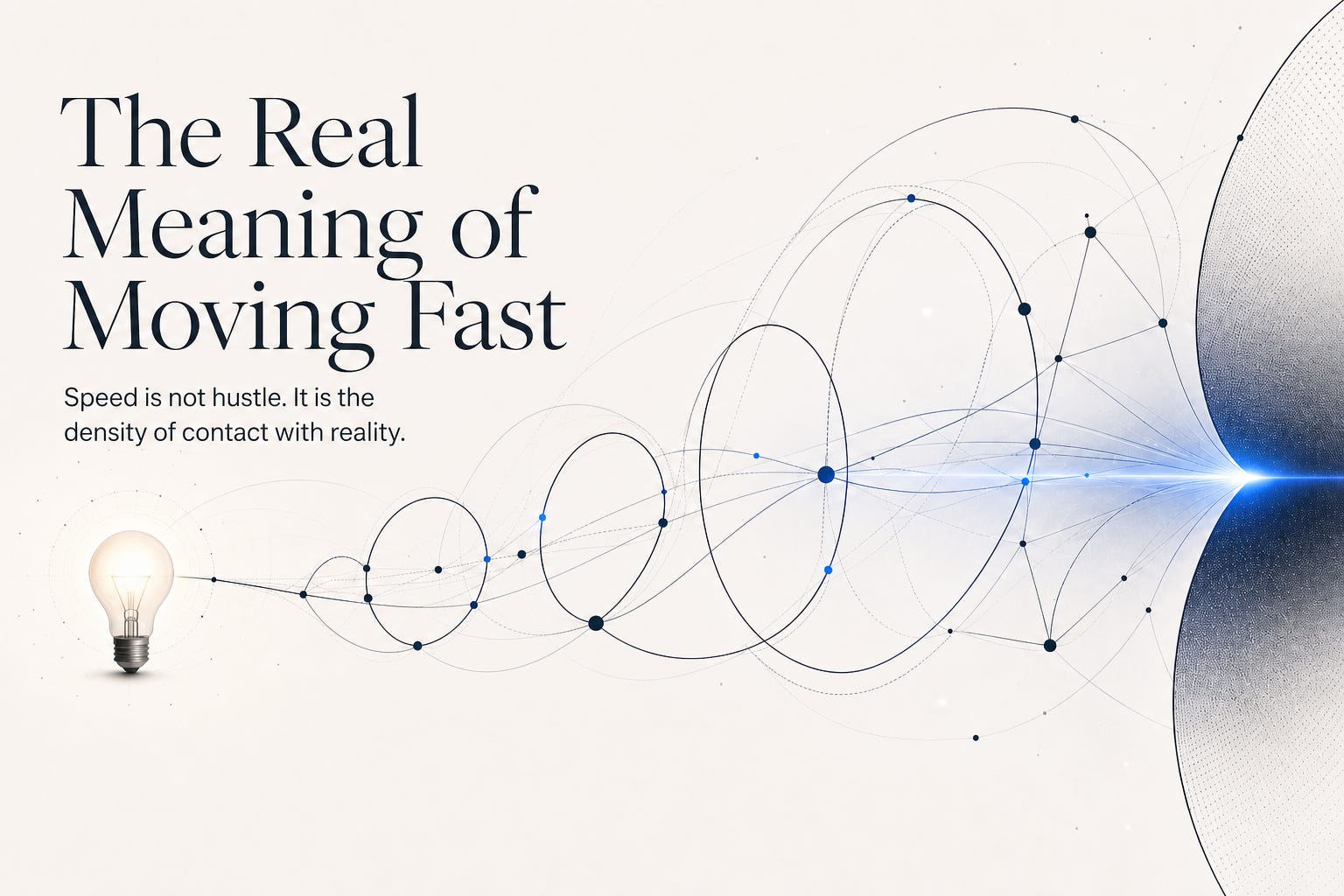
The deeper idea is not about speed for its own sake. It is about increasing the density of contact with reality.
Most people manage time. Great builders manage feedback loops.
They do not simply ask, “How long will this take?”
They ask, “How quickly can I find out what is true?”
That distinction changes everything.
Time Compression Is a Thinking Tool
When someone says, “Take your 10-year plan and try to do it in six months,” the point is not that every 10-year goal can literally be achieved in half a year.
The point is that a 10-year plan often hides lazy assumptions.
It contains inherited timelines, social expectations, unnecessary dependencies, vague sequencing, and work that feels responsible but does not move the core problem forward.
A long timeline lets weak thinking survive.
A compressed timeline forces clarity.
If you had only six months, you would have to ask sharper questions:
What is actually necessary?
What can be deleted?
What can be parallelized?
What can be tested before it is fully built?
What assumption, if false, would make the whole plan collapse?
That is the real value of aggressive deadlines. They expose the difference between essential work and ceremonial work.
A normal plan asks, “What should we do next?”
A compressed plan asks, “What must be true for this to work at all?”
That is a much better question.
Innovation Is a Rate, Not a Trophy
“Innovation per unit time” is a clean idea because it treats progress as a rate of change, not a static achievement.
Many people look at innovation as a possession: patents, technology, talent, funding, market share. These things matter, but they are snapshots. They tell you where someone is today.
They do not tell you how fast that person or company is learning.
In a slow-moving world, static advantages can last for a long time. In a fast-moving world, the slope matters more than the position.
A company that improves once a year may look strong today. A company that improves every week may look behind today, but dangerous tomorrow.
The reason is simple: each cycle changes the next cycle.
You try something.
Reality responds.
You update your model.
Your next attempt is better.
That better attempt produces better feedback.
This is how learning compounds.
The moat is not only what you know. The moat is how fast you can learn what you do not yet know.
That is why speed matters. Not because motion is impressive, but because frequent contact with reality improves judgment faster than private analysis ever can.
Slow systems preserve opinions. Fast systems expose truth.
Long Hours Are Not Magic
The 100-hour workweek idea is the most easily misunderstood.
More hours do not automatically produce better results. In many cases, they produce worse results: fatigue, bad judgment, sloppy execution, brittle teams, and heroic effort wasted on the wrong problem.
But there is a specific context in which extreme effort can create a nonlinear advantage.
If the extra hours increase the number of high-quality feedback cycles, they matter.
Imagine two teams working on the same difficult problem.
One team runs one meaningful experiment per week.
The other runs one meaningful experiment per day.
After a month, the first team has four data points. The second has twenty. But the difference is not merely five times more information. The second team has had more chances to refine its model, correct bad assumptions, simplify the design, and notice patterns the first team has not even encountered yet.
That is where the compounding begins.
The real variable is not hours.
The real variable is cycle density.
Extra time is valuable only when it becomes more experiments, faster decisions, tighter execution, and better learning. Otherwise, it is just exhaustion wearing the costume of ambition.
The Shared Principle
These three ideas are really one idea expressed at three levels.
Compress the 10-year plan: sharpen the problem.
Measure innovation per unit time: track the rate of learning.
Work with intensity: increase the density of useful cycles.
Together, they point to a single principle:
Shorten the distance between idea and reality.
The longer an idea stays abstract, the more it attracts fantasy. People debate it. Polish it. Defend it. Build narratives around it. The idea becomes protected from evidence.
But once it touches reality, the situation changes.
The customer does not care about the deck.
The rocket does not care about the schedule.
The market does not care about internal alignment.
The prototype does not care how elegant the theory was.
Reality is the only honest evaluator.
Fast builders are not necessarily more certain than everyone else. In fact, the best ones are often less attached to their original beliefs. They move quickly because they want reality to correct them sooner.
Speed, at its best, is humility.
It says: I do not want to spend years defending an assumption that could be tested this week.
The Danger of Misreading Speed
There is a dangerous version of this philosophy.
It says: move fast no matter what.
Work longer no matter what.
Compress every timeline no matter what.
Treat rest, reflection, and quality as weakness.
That version is not discipline. It is impatience.
Speed only helps when the system can absorb learning.
If the direction is wrong, acceleration makes the crash arrive sooner.
If the feedback is bad, iteration makes the mistake stronger.
If the team is exhausted, more hours reduce the quality of thought.
If the metric is shallow, optimization creates a shallow product.
This is the part many people miss: the goal is not maximum speed. The goal is maximum learning rate under real constraints.
Sometimes that requires urgency.
Sometimes it requires silence.
Sometimes it requires cutting scope.
Sometimes it requires stopping long enough to see the real bottleneck.
A mature builder does not worship speed. A mature builder uses speed as an instrument.
The Better Question
The cleanest way to apply this philosophy is not to ask:
How can I work harder?
A better question is:
What is the smallest real-world test that can teach me the most important thing in the shortest responsible time?
That question contains the whole doctrine.
Smallest means you remove waste.
Real-world means you seek evidence, not opinion.
Most important means you focus on the key uncertainty.
Shortest responsible time means you value speed without becoming reckless.
This is the difference between intensity and chaos.
Intensity has a target.
Chaos only has motion.
The Final Lesson
Musk’s time philosophy is often described as extreme execution. That is partly true, but incomplete.
At the bottom, it is a philosophy of truth-seeking.
Compress time to reveal what matters.
Increase iteration to learn faster.
Measure progress as a rate, not a story.
Use reality as the judge, not your plan.
The point is not to burn yourself out.
The point is to burn away illusion.