

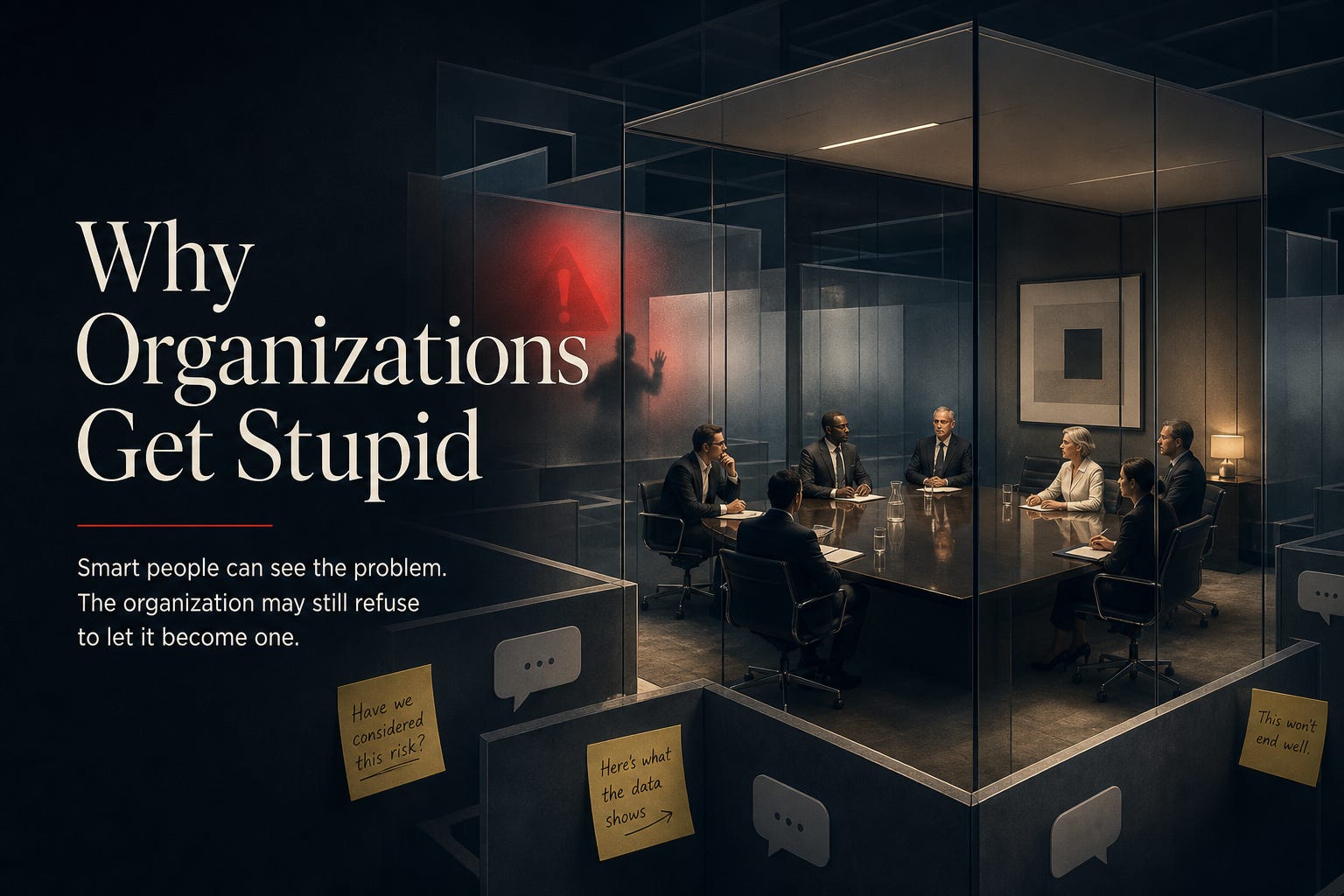
The most dangerous stupidity inside an organization is rarely caused by nobody noticing.
More often, the problem has already been seen. It exists in private conversations, hallway jokes, anonymous feedback, backchannel chats, and quiet resignation. People know. They just cannot get the organization to officially know.
That is the core of functional stupidity.
It is not a failure of intelligence. It is a failure of conversion: a real signal never makes the journey from individual awareness to organizational recognition.
Once a truth becomes official, it stops being just information.
It becomes responsibility.
An engineer privately suspects a product has a serious security flaw. At that stage, it is still only a judgment. But once that judgment enters a report, the whole situation changes.
Who verifies it?
Who approves moving forward?
If the launch is delayed, who explains the delay?
If the launch continues and something breaks, who owns the decision?
Organizations are not always afraid of knowing the truth. They are afraid of being in the state of officially knowing and not yet acting.
That is why bad news is so often softened.
“This design may create a serious security risk” forces action.
“This issue requires continued monitoring” creates breathing room.
Vague language lets the organization stay in a comfortable half-aware state. It can appear responsible without becoming fully accountable.
To understand systemic stupidity, we have to give up one comforting illusion: organizations are not naturally truth-seeking machines.
They are coordination machines.
Their first job is to keep departments aligned, projects moving, budgets justified, promises intact, and authority relationships stable. Truth matters, of course. But truth is welcomed most easily when it does not threaten coordination.
Bad news is troublesome because it slows plans down. It makes prior commitments look fragile. It questions someone’s judgment. It turns a vague unease into a formal agenda item that somebody must handle.
So many organizations instinctively protect coordination over accuracy.
This is usually not a conspiracy. Most people are making locally reasonable choices.
The engineer does not want to be seen as difficult.
The middle manager does not want the project to die on their watch.
The executive does not want to admit the earlier call was wrong.
Legal does not want to create liability.
HR does not want the culture to feel “negative.”
Each choice is understandable on its own.
Together, they destroy the organization’s ability to receive bad news.
And smart people do not automatically fix this. In some systems, they adapt faster.
They quickly learn the real questions:
Who will this embarrass?
Which project will this interrupt?
Will anyone actually own the problem, or will it become mine?
If I speak too directly, will I be seen as solving a problem or creating one?
Their intelligence does not disappear. It gets reassigned.
The same mind that could have been used to understand reality is now used to manage speaking risk. When to say it. How directly to say it. Who to include. Who to leave out. How much evidence is enough. How much honesty is too much.
That is the cruelest part of functional stupidity.
It does not make smart people stop thinking.
It teaches them to think primarily about self-protection.
Many professional management tools can also become substitutes for reality.
Compliance documents can substitute for actual repair.
Brand narrative can substitute for product strength.
Leadership language can substitute for hard judgment.
A “positive culture” can substitute for bad news moving upward.
None of these things is inherently bad. Process, brand, training, and reporting can all serve real work. The danger begins when they detach from reality and start producing evidence that “we are managing the issue.”
Imagine a regulator raises 25 concerns. The organization responds by writing 25 new policies. The regulator is satisfied. The paperwork is complete. But the actual work has not changed.
The absurdity is not that nobody worked.
The absurdity is that the work shifted from changing reality to leaving traces that reality has been changed.
This is how systemic stupidity grows. The organization becomes increasingly skilled at explaining itself and increasingly weak at correcting itself.
The deepest reason is simple: bad news redistributes power.
A bad project is not just a mistaken plan. If it is officially recognized as wrong, budgets may move, leaders may have to explain themselves, supporters may lose face, and early skeptics may gain influence.
What looks like a factual judgment quickly becomes a political event.
That is why the same sentence has different outcomes depending on who says it.
A new employee says, “This process seems broken,” and gets dismissed as naive.
A consultant says, “There is an organizational efficiency bottleneck here,” and people take notes.
A senior executive says, “We need to redesign this mechanism,” and it becomes strategy.
Inside organizations, truth needs evidence, but it also needs authorized identity.
Many problems are ignored not because they are false, but because the person naming them does not have the standing to make them count.
This is why fresh eyes are so valuable and so easily wasted. New people often ask the obvious question: “Why do we do it this way?”
Many organizations answer, directly or indirectly: stop asking why and learn how things work here.
A sharper definition of functional stupidity would be this:
The organization allows people to privately know the truth, but does not easily allow that truth to gain official status.
Private truth does not immediately change resource allocation.
Official truth does.
So the intelligence of an organization does not depend mainly on how many smart people it hires. It depends on whether early signals can become formal judgment.
The path is roughly this:
A vague unease becomes a speakable problem.
The problem gains evidence.
The evidence enters the agenda.
The agenda changes the decision.
Functional stupidity usually happens at the first two steps.
The signal never gets to mature into a problem. It is suppressed early by politeness, hierarchy, performance incentives, and self-censorship.
This is not an argument for endless dissent.
Organizations can die from the opposite disease too: everything is debated, everything is questioned, and nothing moves.
A healthy organization does not ask every person to challenge everything all the time. It builds low-cost mechanisms for important counter-signals to be heard, tested, and allowed to affect decisions.
That requires a few concrete conditions.
The person who finds the problem cannot automatically become the unlucky owner of the problem. If speaking up reliably creates personal punishment, people will learn silence.
Dissent works better when it is role-based. Pre-mortems, red teams, and designated devil’s advocates make risk-raising part of the job rather than a personal act of disloyalty.
Failure also has to leave memory. Many organizations do not merely make mistakes. They package mistakes as lessons, then quickly forget the lesson.
Most of all, organizations have to protect the parts of themselves that still notice when something feels wrong: new employees, edge roles, customer feedback, small anomalies before incidents, and the awkward questions that have not yet been polished into acceptable language.
These are often the first ways reality knocks.
The real test of an organization is not whether it employs intelligent people.
The test is what happens when someone says:
“Something is off here.”
Does the system punish the person?
Or does it verify the signal?
That answer tells you almost everything.